

Transistor is a software company where the founder is actively involved in its videos and marketing, which makes it a useful example of how I would improve a company’s YouTube strategy without getting in the founders way.
So, let’s see how I would turn Transistor’s YouTube channel into a stronger marketing asset.
Current State of the Channel
Transistor is publishing different types of videos on YouTube. These include broad-topic videos, product update, podcast episodes, conference videos, and customer stories.
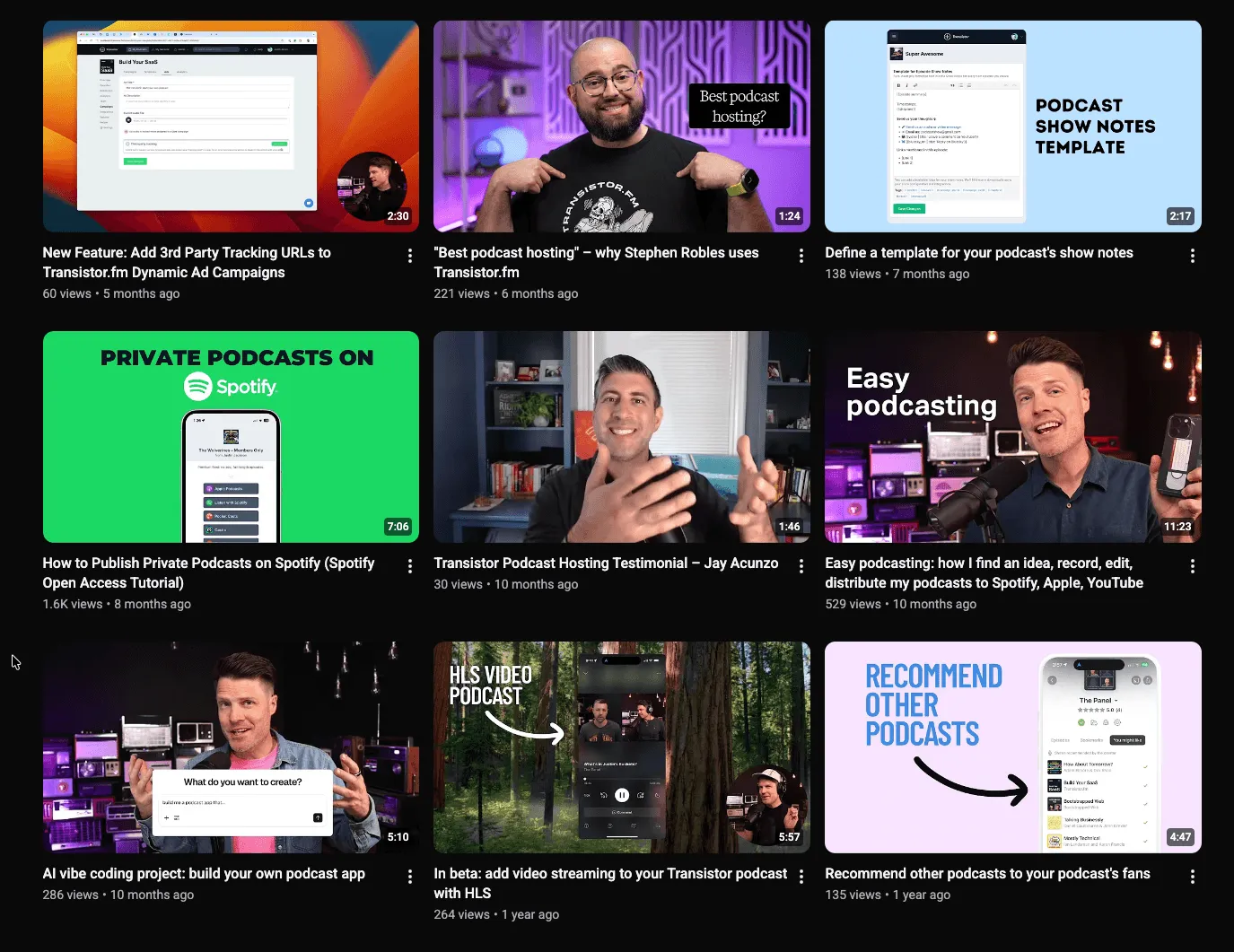
At first, this might look like a healthy mix of content. But each type of video is for a different audience. A beginner looking for advice on starting a podcast doesn’t necessarily care about a Transistor product update or conference recap.
This is one of the business mistakes I see on YouTube: using the channel as a video repository instead of asking whether the same viewer will want to watch most of the videos.
You can see the difference in the view counts. Transistor’s most popular videos about broader podcasting problems have between 24K and 78K views.
Meanwhile, most recent product tutorials have fewer than 600 views. The MCP video got only 22 views in two weeks, and the Podcast Show highlights got 62 views in two months.
The older videos have had more time to collect views, so this isn’t a perfect comparison. But the pattern is clear: videos about problems podcasters care about reach more people than product announcements or company updates.
Let me show you why I would start by fixing the channel’s visual identity.
Change 1 - Create a Consistent Visual Identity
The first change I would make is creating a more consistent visual identity for the channel.
Right now, Transistor uses at least four different thumbnail styles:
- Justin’s studio as the background, yellow text, and platform logos;
- product or browser screenshots;
- flat graphics and diagrams;
- and event or interview footage.
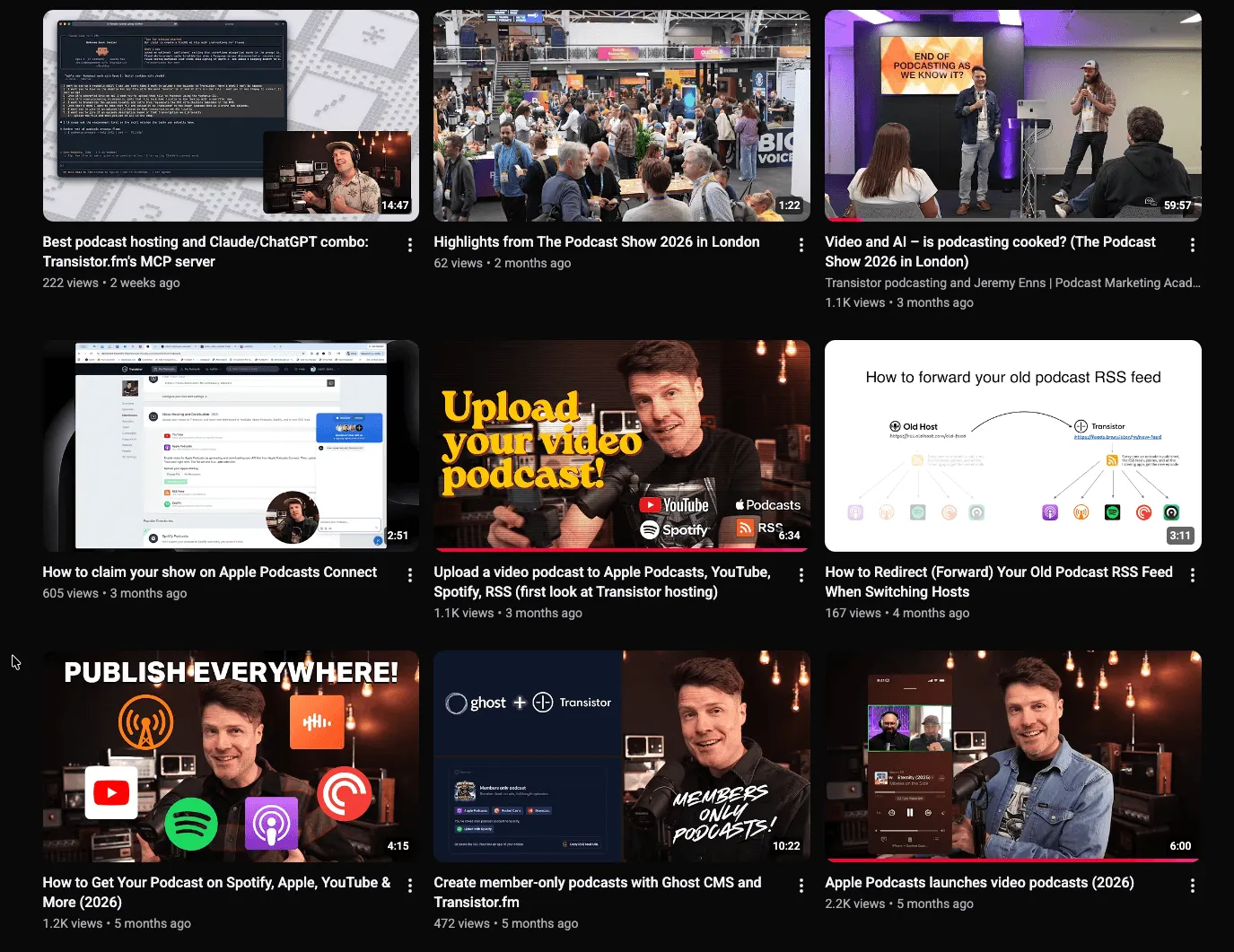
Each style can work on its own, but together they don’t look like they belong to the same channel. There isn’t enough consistency across thumbnails to make a Transistor video recognizable at a glance.
The studio thumbnails are the closest thing Transistor has to a visual system. They already use Justin’s studio background, yellow text, and podcast platform logos.
But the number of words, screenshots, logos, and arrows changes too much from one thumbnail to another. Also, some product screenshots used are difficult to read and look more like internal documentation than a reason to click.
Fortunately, Transistor doesn’t need to start from scratch. The channel’s strongest videos already show what the visual identity should help communicate:
- “See your podcast stats for Spotify, Apple Podcasts, YouTube” has 78K views. The multi-platform outcome is the hook, while the dashboard proves the result;
- “Starting a podcast in 2025: worth it?” has 45K views. The thumbnail asks “WORTH IT?” and shows Justin holding a microphone;
- “Don’t start a video podcast” has 28K views. The thumbnail crosses out “VIDEO PODCAST” to make the warning clear;
- and “Switch to a new podcast hosting service (without losing listeners)” has 24K views. The title focuses on the risk podcasters care about when switching hosts.
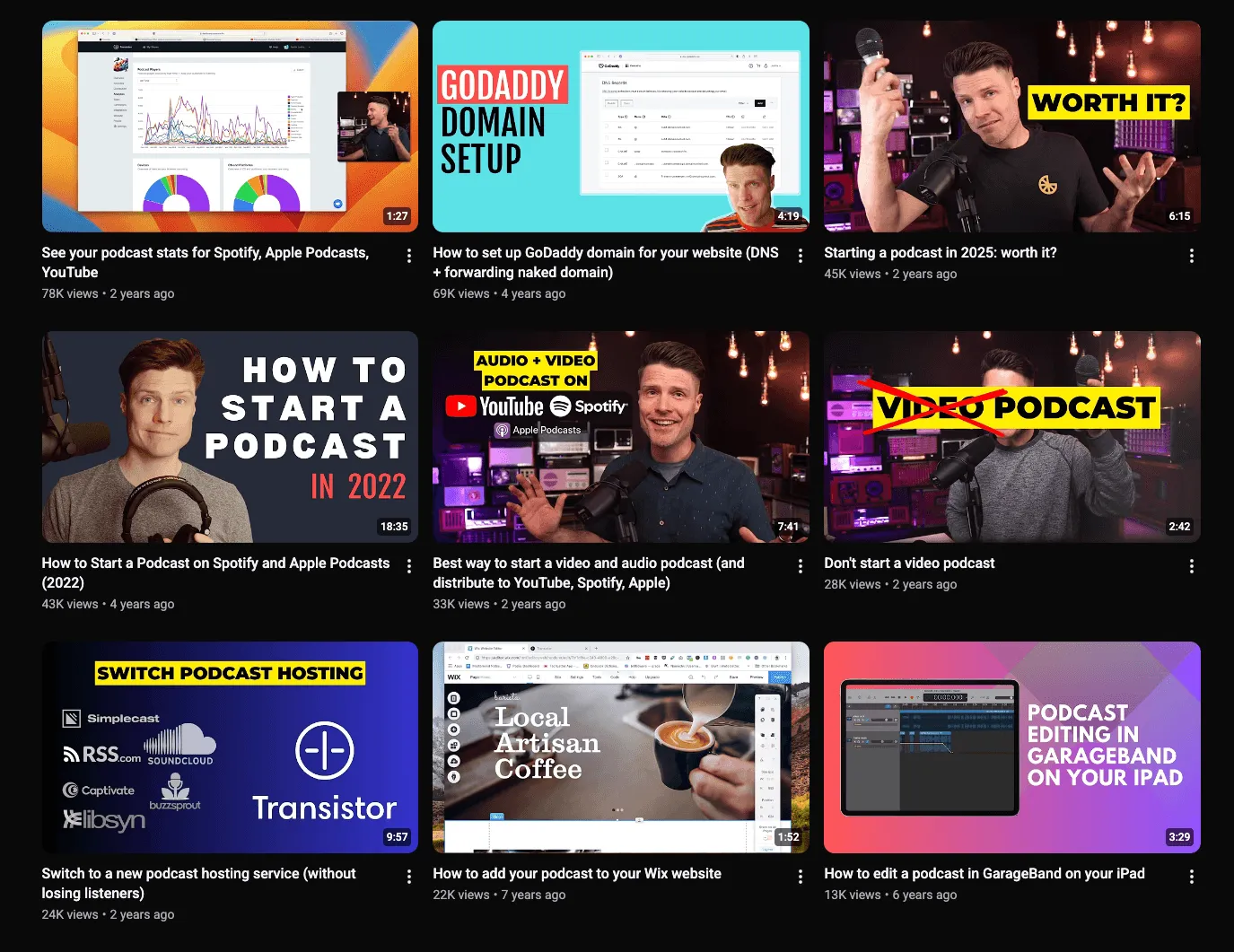
These thumbnails don’t use the same layout, but they follow similar rules. They lead with a viewer problem or outcome, use one main visual, and keep the thumbnail text between two and five words. In these videos, Transistor appears as proof that the company can help, rather than being the main reason to click.
Here’s how I would turn these patterns into thumbnail guidelines:
- use Justin’s studio background as the base style;
- use
#fded02as the main accent colour; - use Montserrat ExtraBold/ Black for the text (the most common font already used);
- and use one or two supporting visual elements like logos.
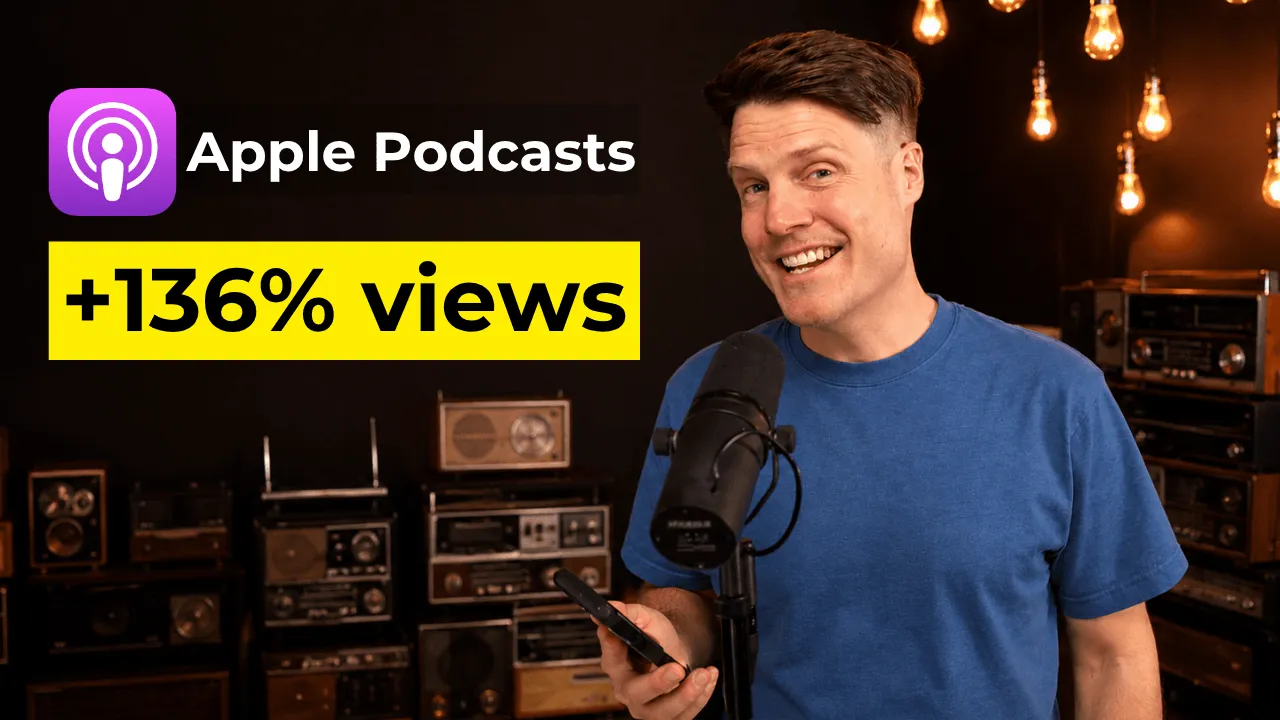
These guidelines don’t intend to make every thumbnail look the same. A recognizable identity can come from repeating a small number of elements. For example, Ahrefs uses its famous font and orange colour, Rob from VidIQ repeats the blue glasses, and Tom Scott became recognizable through his red shirt.
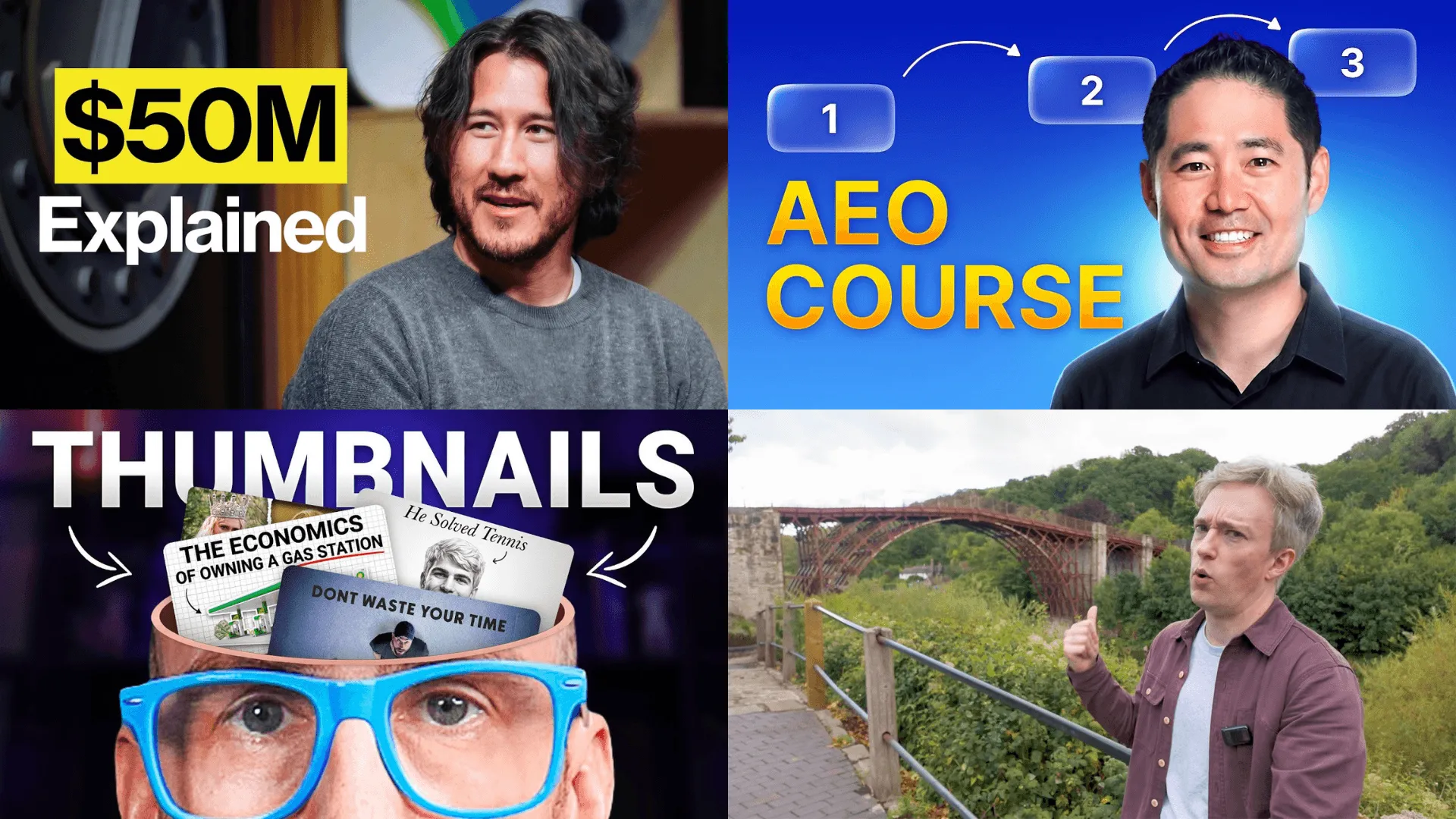
The video titles should follow the same idea. Instead of leading with a feature, they should appeal to an emotion or outcome using popular title formulas.
Below you can see two thumbnail examples I created using this system.
The first uses Justin’s studio, the yellow accent, and a specific result. The second shows how the same font, color, and Justin’s image carry the identity even without the studio background.
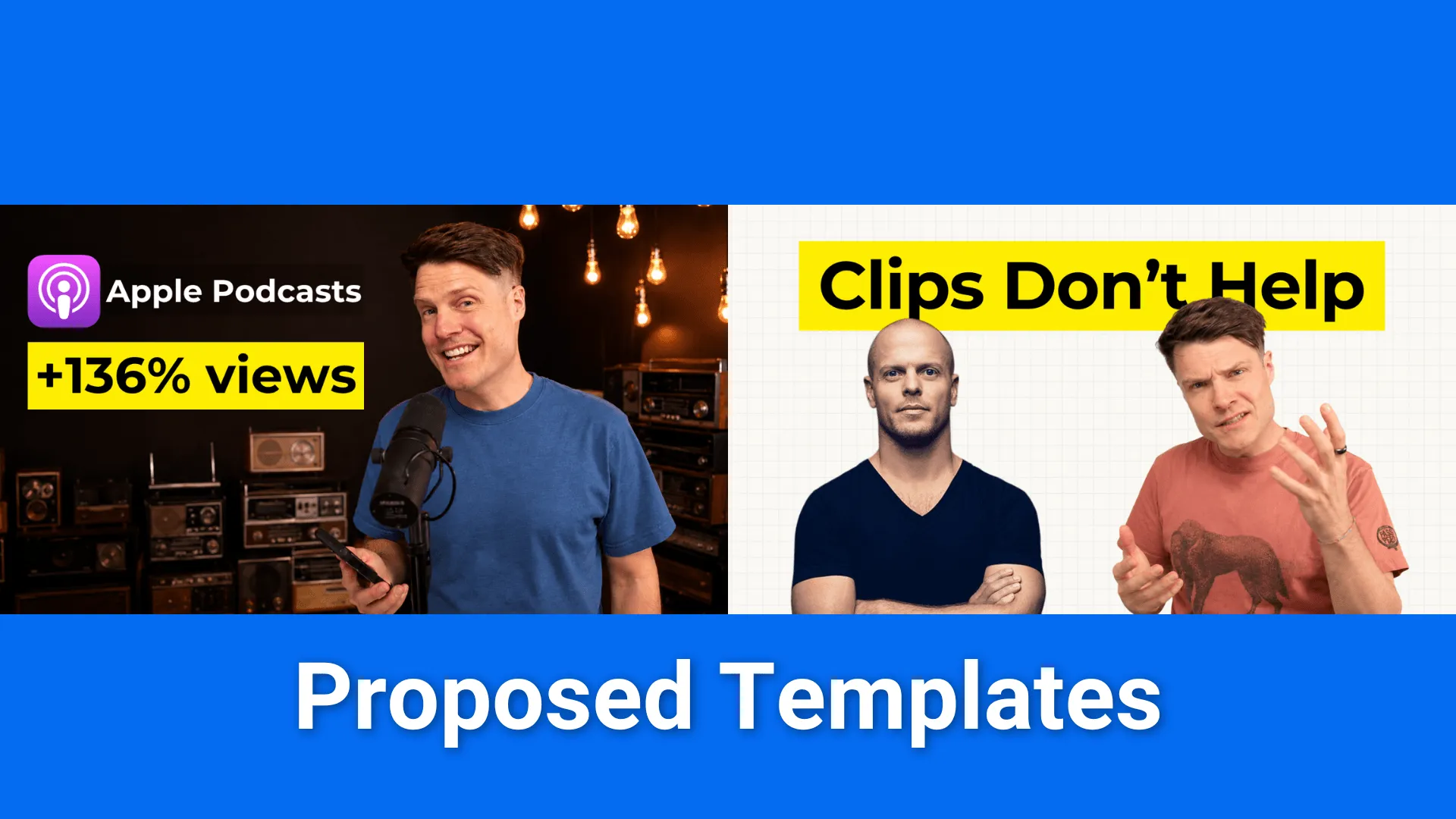
Takeaways to create a consistent channel identity:
- Decide the template rules like font, color, background style, and text placement;
- Use one dominant visual and one supporting proof element to keep the composition clean.
Join for tips on growing a bussiness with video
Change 2 - Founder-led Content System
The second change is building a content system around Justin’s knowledge and strong personal brand.
Transistor already has an advantage: Justin appears on camera a lot, and he has a strong personal brand, which makes people want to listen to him. What Justin publishes is more personal and opinionated than a typical company account.
I wouldn’t replace that with a rigid content calendar or tell Justin what he must talk about. That would turn making videos into a chore and I’m sure he doesn’t want that.
Instead, the process would work like this:
- Let Justin bring the bring ideas based on product knowledge, opinions, stories, and examples;
- I help turn those ideas into useful videos for Transistor’s audience;
- and I would package each idea with a title and thumbnail that can work on YouTube.
I would also propose some video ideas for Justin’s consideration and help brainstorm the content production.
The important part is that Justin is the cheat code. Other podcast companies can copy a topic or feature, but they can’t easily copy his experience, opinions, relationships, or personal brand. Using those things would create a channel moat and make Transistor’s videos more difficult to replicate.
The channel also needs one clear audience to keep ideas focused. For this example, I would position it as “The channel for serious podcasters”.
Then I would organize the ideas into five content pillars:
- Growth;
- Monetization;
- Content, distribution, and strategy;
- Case studies, industry stats, research, and experiments;
- Commentary and news about changes in the podcast industry.
These pillars are broad enough to give Justin room to follow his interests, but focused enough to make the channel useful to the same type of viewer.
Let’s use dynamic audio insertion as an example.
Transistor could make a product update explaining how the feature works. But that video would mostly appeal to existing customers who already know what dynamic audio insertion is.
A stronger idea would be “Can Old Podcast Episodes Still Make You Money?” The video could show how Acquired sells its back catalogue each season and likely charges higher rates as the podcast grows for the same episodes.
Dynamic audio insertion becomes part of the explanation, but the main reason to watch is learning how a successful podcast makes more money from old episodes.
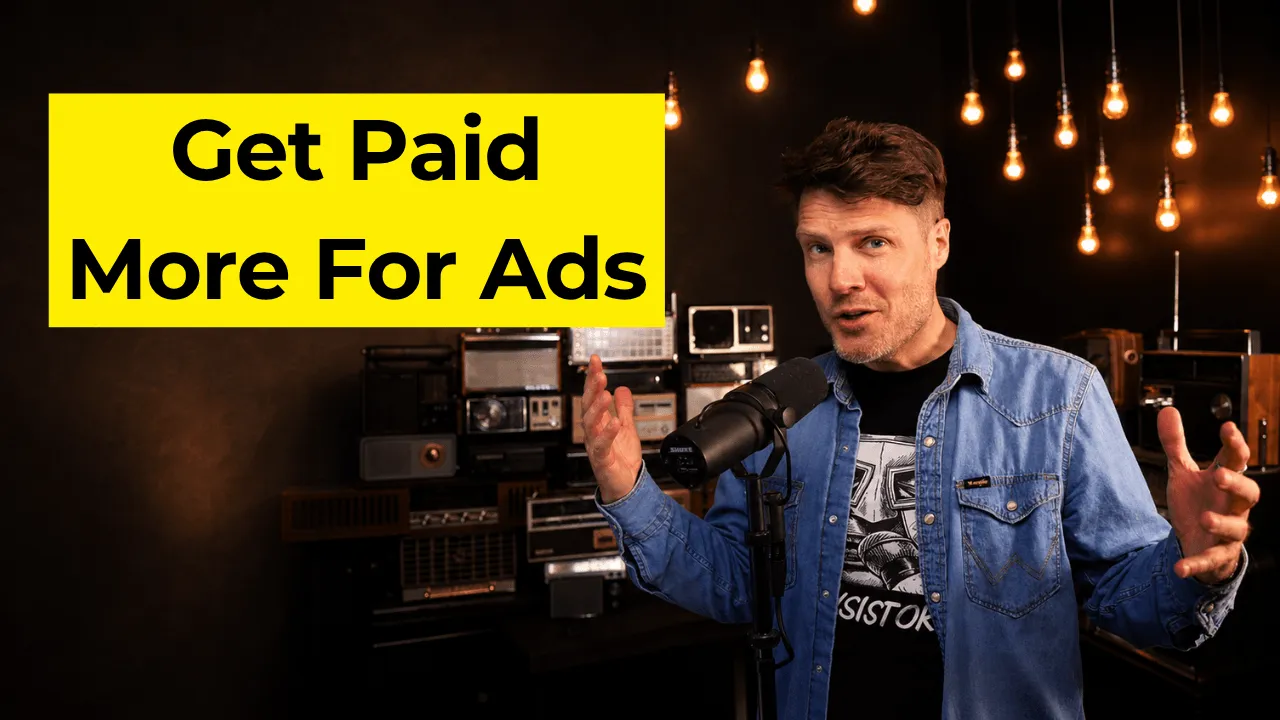
This is what I mean by making the audience’s interests the focus and mentioning Transistor only when the product helps explain the outcome.
Here is a channel mockup about how things could look after applying this content system:
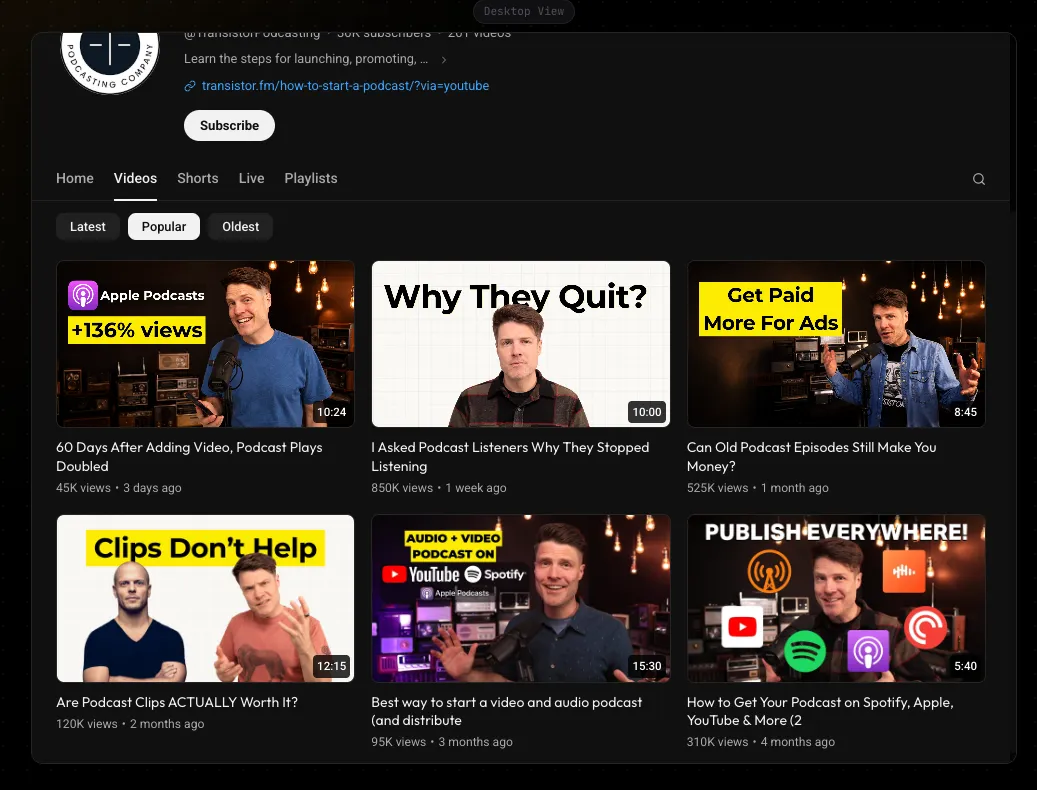
The mockup includes videos about what happens after adding video to a podcast, why listeners stop listening, making money from old episodes, and whether podcast clips are worth the effort.
These are different topics, but they all serve the audience (serious podcasters) and use Justin’s experience as part of the value.
Takeaways to build a founder-led content system:
- Use the founder’s knowledge, opinions, and examples to make content that’s difficult to copy;
- Mention the product when it helps explain the outcome instead of making it the main focus.
Read about VidIQ’s strategy to show how a software company has been making content focused on the audience’s needs for years.
Change 3 - Start a 2nd YouTube Channel
The third change is the most drastic: I would start a second YouTube channel for Transistor product videos.
Please bear with me for a minute.
The main channel goal should be attracting podcasters who could become Transistor customers. But someone who subscribes for advice on growing a podcast has little reason to watch a Transistor feature update if they don’t use the product.
Product update videos still matter. It just does a different job: helping customers get the most of the service, rather than giving a new viewer a reason to watch Transistor’s videos.
I would solve this by giving each channel one job:
- The main Transistor channel would become a marketing channel;
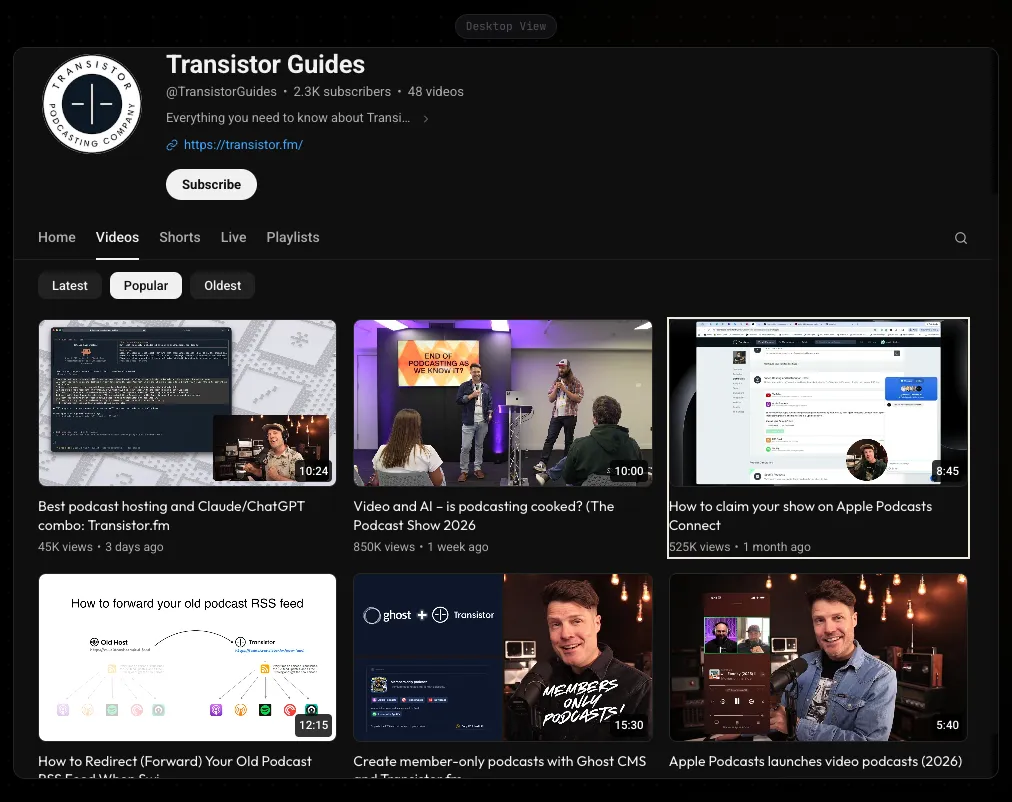
- The second channel, called ‘Transistor Guides’, would publish product updates, guides, testimonials, and customer education.
The second channel wouldn’t need thousands of views to be successful. Its job would be helping customers use Transistor and building a deeper connection with them, not reaching every podcaster on YouTube.
This is already a common approach among software companies. VidIQ has a separate tutorials channel; Ahrefs is also publishing product videos on Ahrefs Updates. Proton and Shopify also separate product education from broader content.
A smaller subscriber count doesn’t stop those product channels from doing their job. When I checked, VidIQ Tutorials had around 4.9K subscribers with videos typically getting 3K-6K views. Ahrefs Updates had around 6.3K subscribers and typically got 2K to 4K views.
In contrast, a large subscriber count doesn’t guarantee that product videos will get watched. ClickUp has more than 100K subscribers but often struggles to reach 1,000 views. GitHub has around 680K subscribers, and many videos get between 2K-8K views.
I’m not saying that every company needs two channels. The point is that no matter the subscriber count, asking one YouTube channel to appeal to unrelated audiences is a bad idea.
But I wouldn’t delete Transistor’s existing videos.
Instead, I would clean up the current channel in stages:
- First, create playlists for product updates, product guides, testimonials, and other existing video types;
- Second, unlist old videos that don’t fit the new strategy and no longer receive impressions because YouTube isn’t recommending them anyway;
- Later, review videos that still get impressions but almost no views and gradually unlist the ones that don’t fit the new strategy.
In the meantime, I would start publishing all product videos and guides on the new channel (Transistor Guides). This keeps useful videos available while giving the main channel a clearer direction moving forward.
The main channel would focus on audience-first videos for serious podcasters. Transistor Guides would become the home for product education and updates.
Takeaways for separating channel audiences:
- Don’t make one channel do two different jobs for unrelated audiences;
- Keep broad videos (marketing, education, etc) separate from product education;
- Product education doesn’t need a massive number of views to be useful to customers.
Landing the Plane
Transistor has a good opportunity to turn YouTube into a stronger marketing channel.
Justin’s knowledge and personal brand give the company something others can’t easily copy, which makes the channel worth investing in.
If you want me to audit your company channel, contact me. I audit YouTube channels and create strategies to help businesses grow and sell with video content.