
I audited Flodesk’s YouTube channel and noticed it’s mostly used for customer education and product promotion. So let’s see what changes could make the channel more attractive to a YouTube audience.
YouTube channel analysis
The main problem I see on Flodesk’s channel is that the videos target only a warm audience. You need prior knowledge of the brand or a real interest in Flodesk to watch these videos.
Look at the recent titles used:
- Masterclass Replay: Grow a Smarter List Before Black Friday;
- Export your email with Flodesk Studio;
- Customize your email in the Flodesk Studio builder;
- Workshop Replay: Welcome to Flodesk Studio;
- How to A/B Test Subject Lines in Flodesk (Full Tutorial).
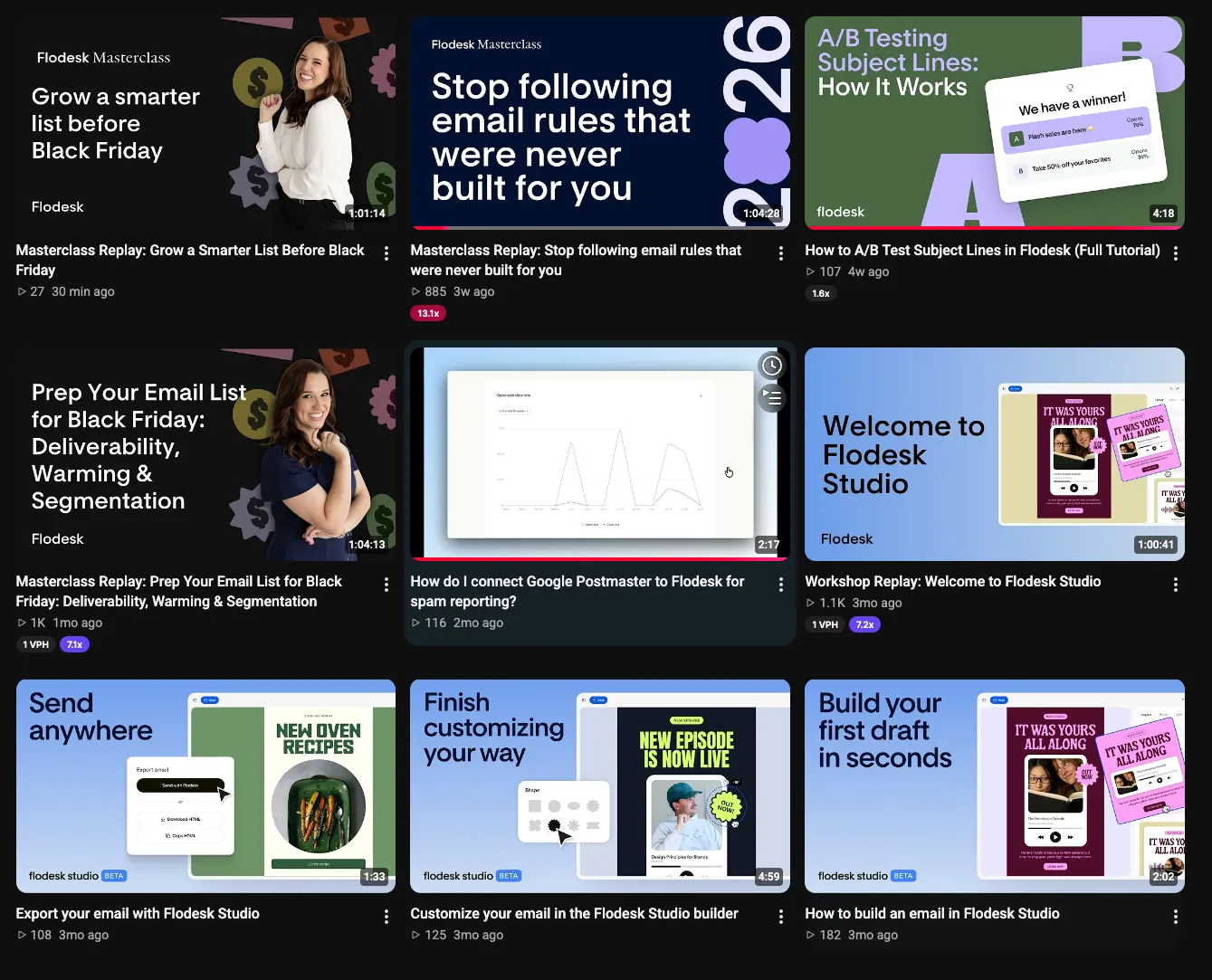
The thumbnails follow a similar pattern: Some are only text, and others are full of logos and too much clutter.
The most-watched recent videos have around 1000 views, and they’re basically all workshop/masterclass replays. The tutorials and product videos get 100-300 views, which is very low.
These videos are focused on the features, so a cold audience currently has zero reason to watch their content.
As Paddy Galloway says: “So many mistakes in YouTube strategy come from tailoring too much to the core and just making these videos that are super niche.”
My suggestion is to follow the good example of vidIQ or ahrefs by making videos more broadly appealing so they start attracting cold audiences.
This means making the videos appeal to their emotions and desires, which gives them a reason to watch even if they don’t know anything about Flodesk.
If Flodesk starts making broader videos, I see two benefits.
First, the videos become more effective marketing material, not “just” educational content. Almost nobody wants to watch tutorial content anyway.
Second and most important: Higher views potential. Even if Flodesk doesn’t change much of what they publish, the same videos can get more views and attention.
Let me show you how by repackaging existing videos.
Join for tips on growing a bussiness with video
Make titles and thumbnails more broadly appealing
Let’s start with the video on their channel using the title: ‘Masterclass Replay: Grow a Smarter List Before Black Friday’.
This title and thumbnail aren’t clear because the wording smarter list means nothing to a cold audience.
In a nutshell, the video teaches how to segment a newsletter to make more money.
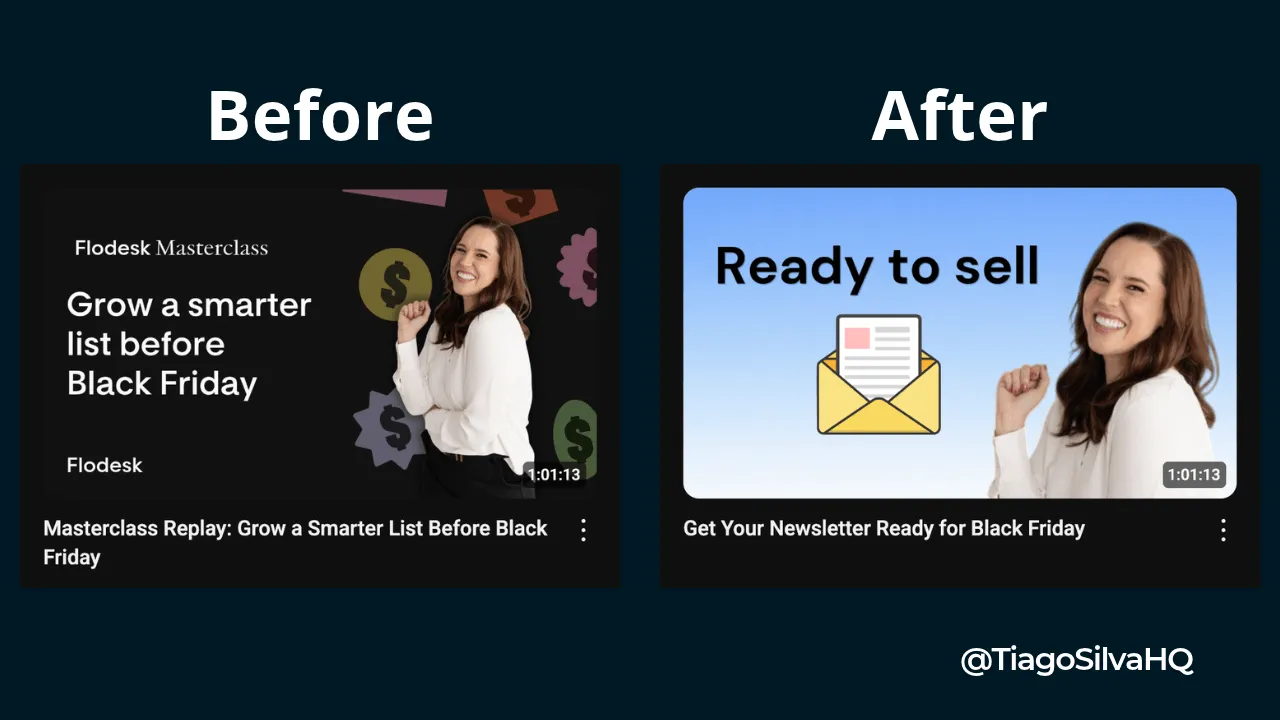
So, I took that thumbnail and title and applied some YouTube best practices.
I started by removing the logos because they don’t serve the outcome the audience wants, and zoomed in on the presenter (Dawn).
But the change that matters most is the text on the thumbnail and the title. Both now appeal to the audience’s emotions and desires: selling more with their newsletter.
This is the same principle that successful creators use even when they make a video about a feature.
I would apply similar principles to feature videos:
- Remove logos and clutter;
- Define 1 focal point for the thumbnail;
- Make the text more intriguing;
- Pick a title based on the outcome.
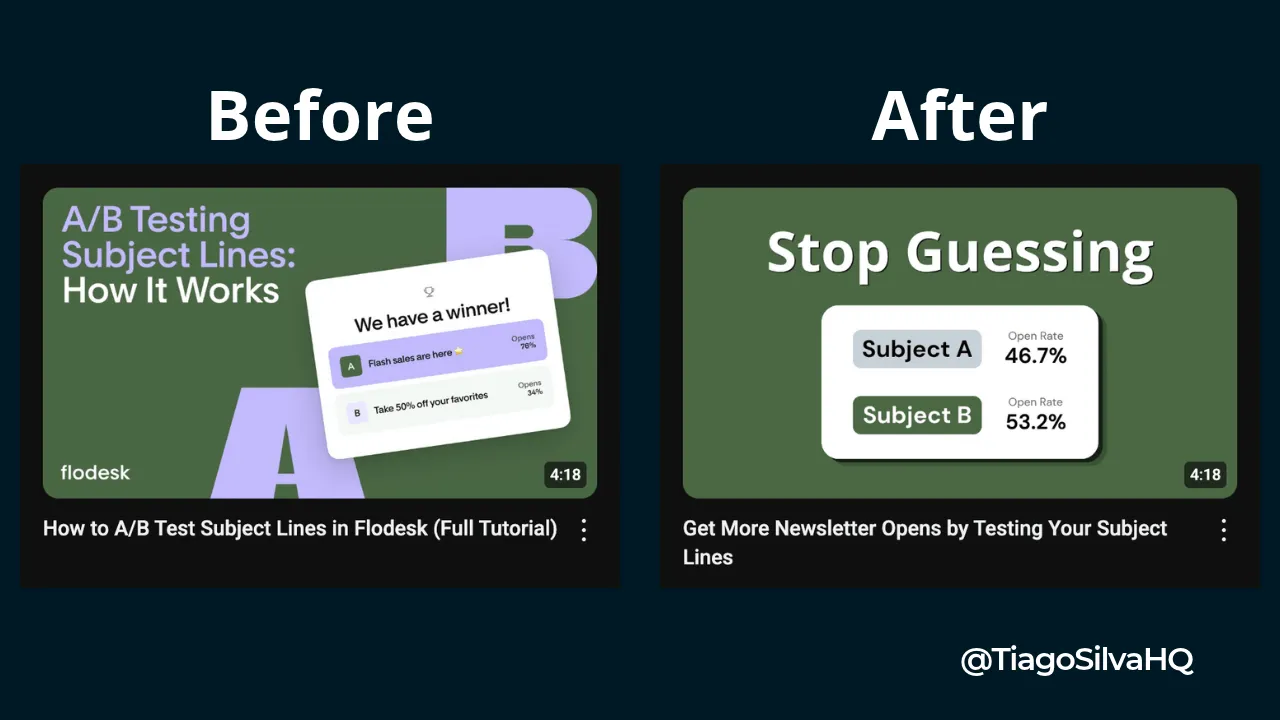
That’s how the video titled ‘How to A/B Test Subject Lines in Flodesk (Full Tutorial)’ would become ‘Get More Newsletter Opens by Testing Your Subject Lines’.
The titles alone can make a difference too, by changing extremely specific language into something with broader appeal.
Here are a few examples:
- ‘How do I connect Google Postmaster to Flodesk for spam reporting?’ → ‘Is Gmail Sending Your Newsletter to Spam?’
- ‘Workshop Replay: Welcome to Flodesk Studio’ → ‘Spending Hours on One Newsletter? Try This Instead’
- ‘Export your email with Flodesk Studio’ → ‘The Easiest Way to Reuse Your Newsletter Design’
- ‘How to build an email in Flodesk Studio’ → ‘How to Make Newsletters Look Professional’
Add Hooks at the start of videos
My suggestion for the live streams is to edit them and put highlights at the start. If Flodesk or any company thinks a live stream is worthy of being uploaded to YouTube, adding interesting bits at the start as hooks is the minimum.
This is similar to what popular podcast shows do on YouTube.
So I made one example with the same masterclass replay mentioned above. I basically took 2 nuggets from the live and put them at the start.
The 1st is Dawn at 2:43 saying she made an extra 6 figures with email. This serves as social proof that she knows what she’s talking about.
The 2nd is the stat from their study: Flodesk customers who sent to segments saw 4x more opens and 3x more clicks than when sending to their whole list.
These changes make the first 30-40 seconds of the video establish credibility and give a tip to viewers (segment the newsletter). This warms up the audience a little bit about what comes after and gives them more reasons to watch a 1-hour video.
If we promise something like how to prepare your email list for Black Friday, and then they see a presenter spend 2 to 5 minutes welcoming people and saying hello, the colder audience will stop watching. Yes, even with high levels of energy and a super warm voice, like Dawn.
No one is going to wait 5-10 minutes to get what they expect from the title.
Paddy Galloway says: “I have seen 60 to 70% of viewers leave. It nearly always is because you click the video and you’re just not getting what you came for.”
I’m not saying that just putting 2 hooks/highlights will make viewers stay through the full video. But the highlights show interesting things that may be worth sticking around for, and they confirm viewers clicked on the right video.
The goal of putting the highlights at the start is delivering on the click as early as possible.
Coming up with better video ideas
Changing the titles and thumbnails of the videos already published only goes so far.
So to take Flodesk’s channel to the next level, they need to find better video ideas and ways to present them.
This means looking at the audience’s desires (aka. jobs to be done) and making videos that achieve what the audience wants, then showing how to do it with Flodesk, without having to shove the product or make it the main point of the video.
These are similar to the suggestions I made in my Ghost and Transistor audits.
Always start with research to know what is working on YouTube.
Research outlier videos (the ones getting a lot more views than usual for their channel), as they show which ideas and packaging people are clicking on.
This is an established best practice that helps fit the ideas into formats that have higher chances of getting views.
It can work both ways: start from an audience goal and find an outlier format for it, or start from an outlier and adapt a goal to its packaging.
Only after the idea is chosen and packaged come the script and the rest of production. As Ed Lawrence says: “There’s no point wasting my time on a video until I have packaged it.”
I made a shortlist of ideas for the Flodesk audience and matched them with outlier formats. They would still need to be worked on to be usable, but they’re the basis for what the channel could make next.
What to Put in Your Newsletter When You Have Nothing to Say
One of the things Flodesk’s audience wants is to know what to write about, so they actually send emails regularly.
And switching tools doesn’t fix it, as Celine Navarro wrote after moving her newsletter to a different tool.
Here’s how I could turn this idea into a video:
- What we want to show: there are plenty of things to send.
- The outlier formats:
The [X] tier list, orEvery [X] ranked. - Possible Title: ‘Every Type of Newsletter, Ranked’.
- Why it fits: “nothing to say” is really “I don’t know which options are worth it”. And a ranking helps with that.
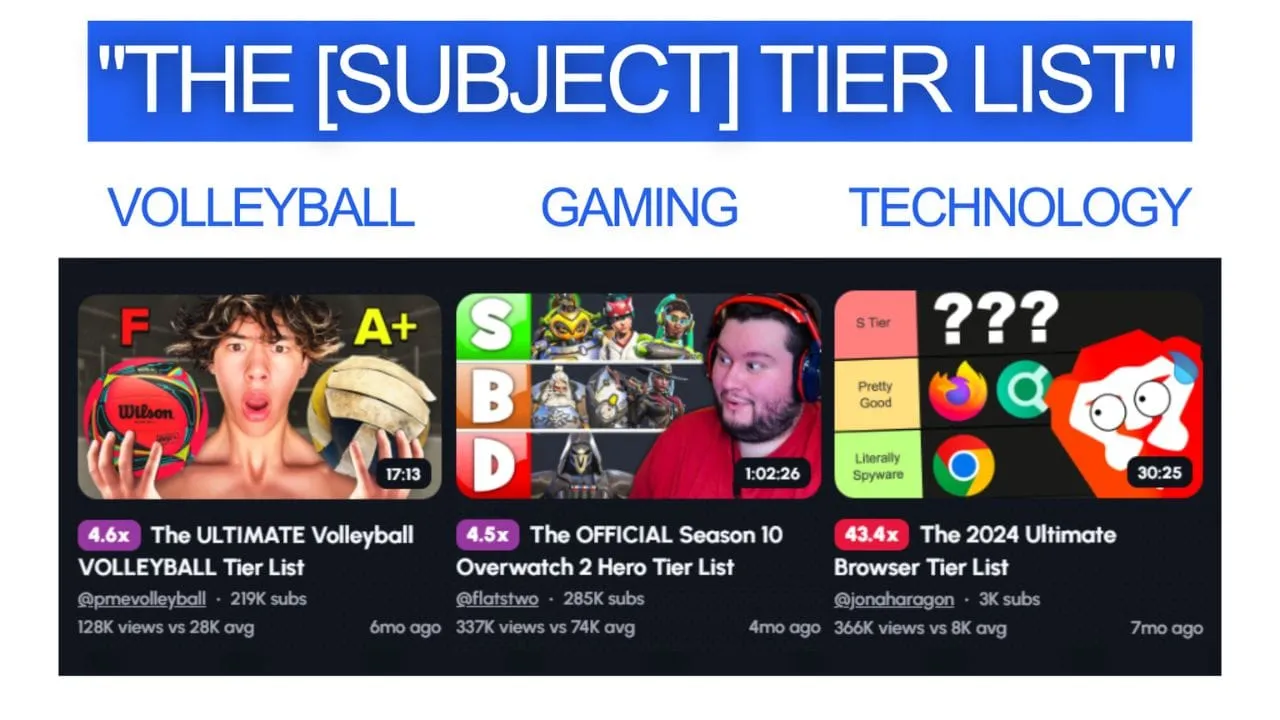
Image credits: https://1of10.com/
This $29 Guide Made $45,000 in One Month
Jessica Hawks sent her TikTok followers to an email waitlist and then emailed them the launch offer. She reports $45,000 from a $29 guide in the first month.
This idea already is an outlier format: [small thing] produces [big result].
$29 is the small input, $45,000 the big outcome. The thumbnail only needs to make that gap visible: ‘$29’ small, an arrow, ‘$45K’ huge.
Why Half Your Subscribers Ignore Your Emails
Sending everything to everyone trains people to ignore you, and sending based on their interests is a solution.
It’s the same topic as ‘Segmentation Secrets’, one of the most-watched videos on the channel, with a problem-led title.
The format is Never [X]. Do this instead.
This type of video needs a familiar mistake, and almost every small creator makes this one: ‘Send to: All subscribers’.
And the title could be: ‘Stop Sending Every Email to Your Whole List. Do This Instead.’
I Gave Myself 1 Hour a Week to Write a Newsletter
The original idea is ‘how to stop wasting time writing a newsletter’.
Inspiration comes from an interview with Martha Bitar (Flodesk’s founder), where she said some writers spent 6 hours on an email and never sent it because it didn’t look on-brand.
Flodesk could make a bold video out of it by putting a hard limit on the writing time.
I know this idea makes a massive promise that’s hard to believe. It could work as an experiment, showing what happens when a writer only has 1 hour a week to write a newsletter, or as a video with tips on how to get there.
It could use the format I tried [X] for [time]. Here's what happened, like the video ‘I Gave Myself 365 Days to Become a Full-Time DJ’.
Landing the plane
Flodesk has a good opportunity to start using their YouTube channel as a marketing channel instead of just a support and advertising channel.
The masterclasses are the only thing I see working right now. Dawn’s Black Friday masterclass had about 1750 people registered for the live, and the YouTube replay has fewer views than that.
Around 1000 views is on the low end of what these videos could get. With better packaging, hooks at the start, and broader video ideas, the channel can start reaching people who don’t know Flodesk yet.
If you want me to audit your company channel, contact me. I audit YouTube channels and create strategies to help businesses grow and sell with video content.